Step 1
Start from OpenAI's own chart
The GPT-4 page plots loss against compute for ten models. The x-axis is normalized so GPT-4 sits at 1, which hides the absolute compute.
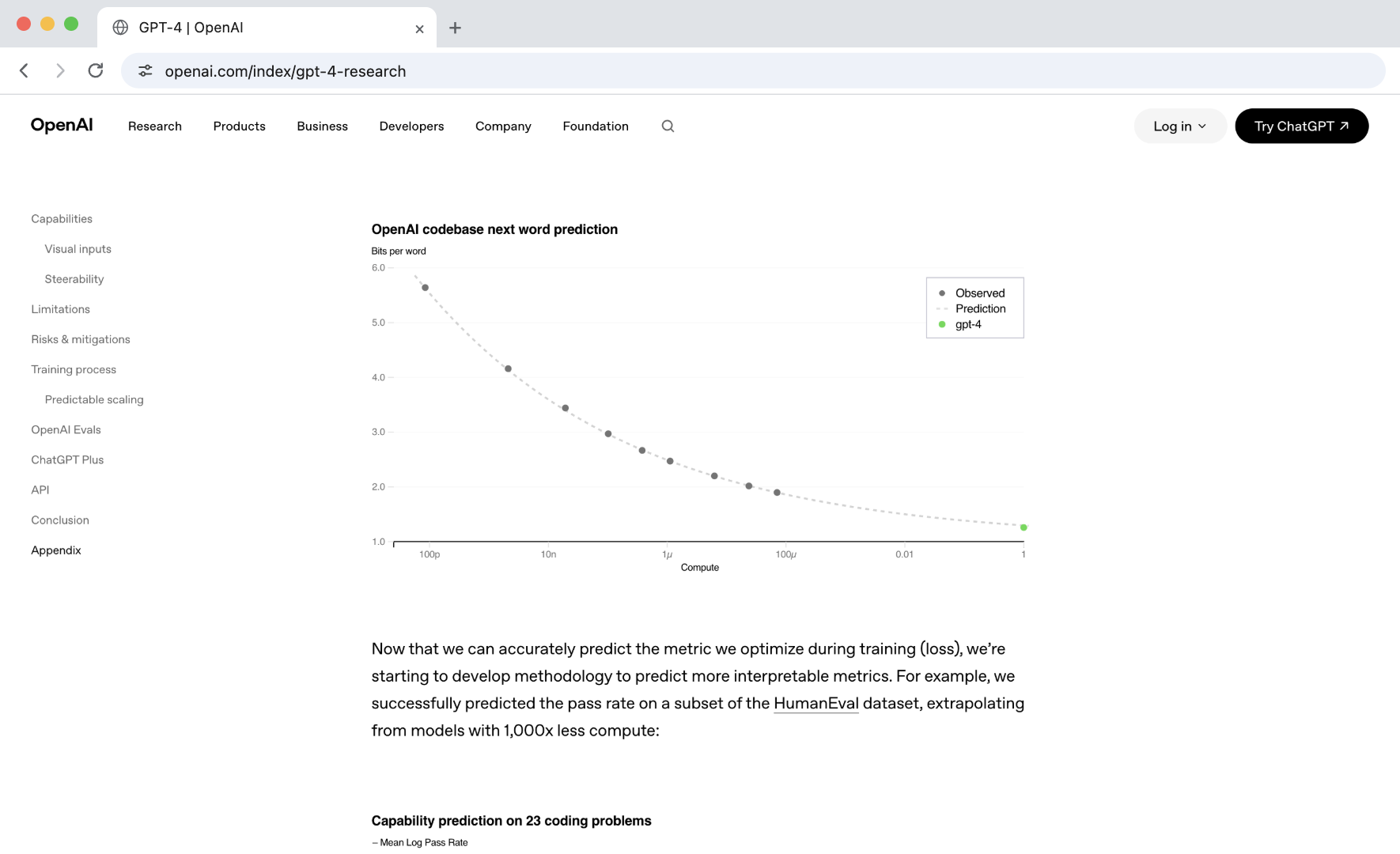
We were checking Wenhao Chai's estimate that GPT-4's scaling law has an irreducible loss of about 0.706. OpenAI's chart source answers it: the plotted fit uses E = 0.71 nats per token. The same source also contains GPT-4's training compute.
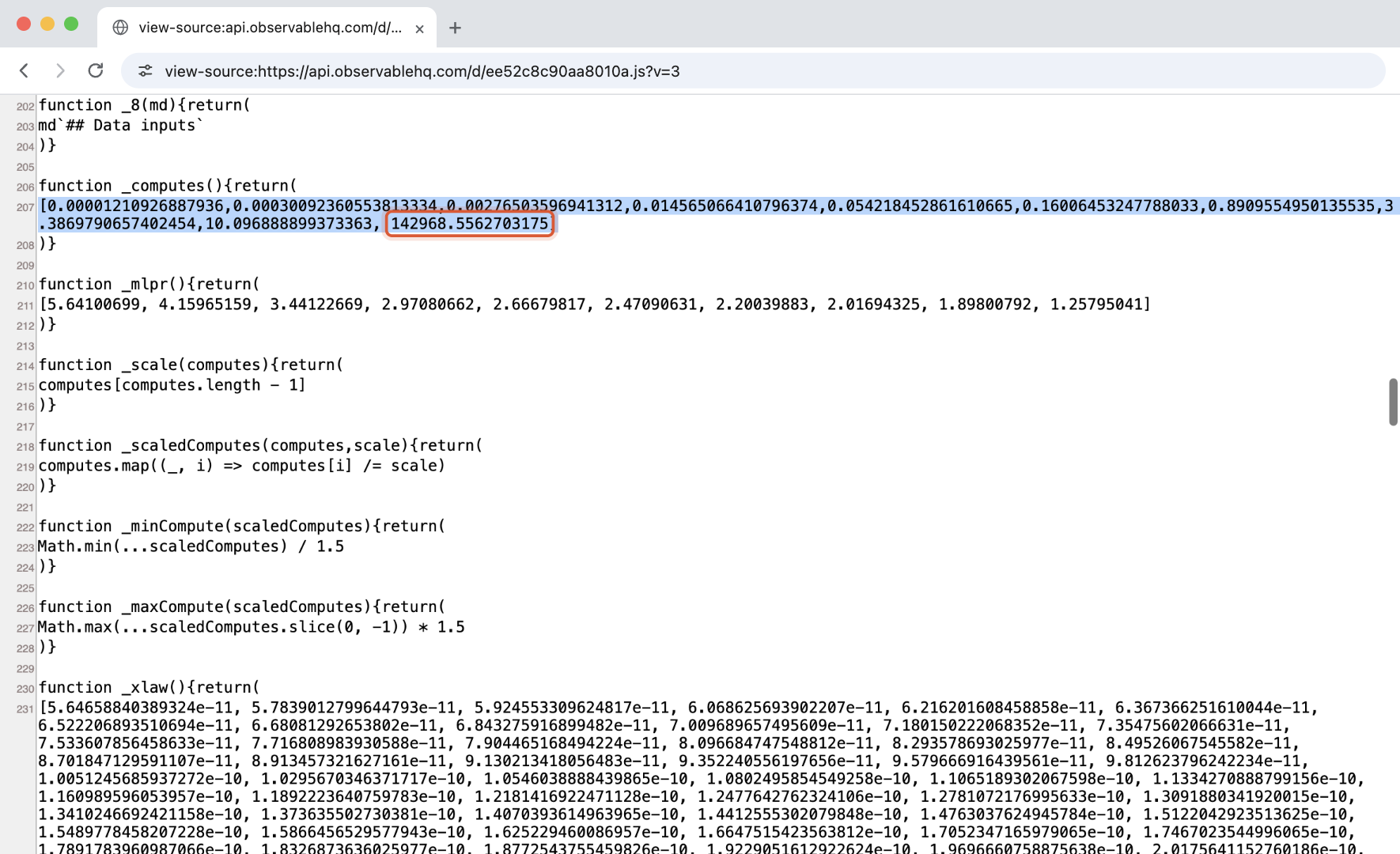
GPT-4's training compute is 1.235 × 10²⁵ FLOP. The value sits in the public source of the scaling chart on OpenAI's GPT-4 page, next to the nine smaller models OpenAI used to predict GPT-4's loss. The source has no unit label. We read it as PF-days, the unit in which all nine smaller models decode exactly.
The curve is L(C) = 0.802 · C−0.122 + 0.71, with C in PF-days and L in nats per token. The constant 0.71 is the irreducible loss E, recovered directly from all 1,000 plotted curve points. At GPT-4's compute it predicts 0.898. GPT-4 measured 0.872.
The GPT-4 page plots loss against compute for ten models. The x-axis is normalized so GPT-4 sits at 1, which hides the absolute compute.
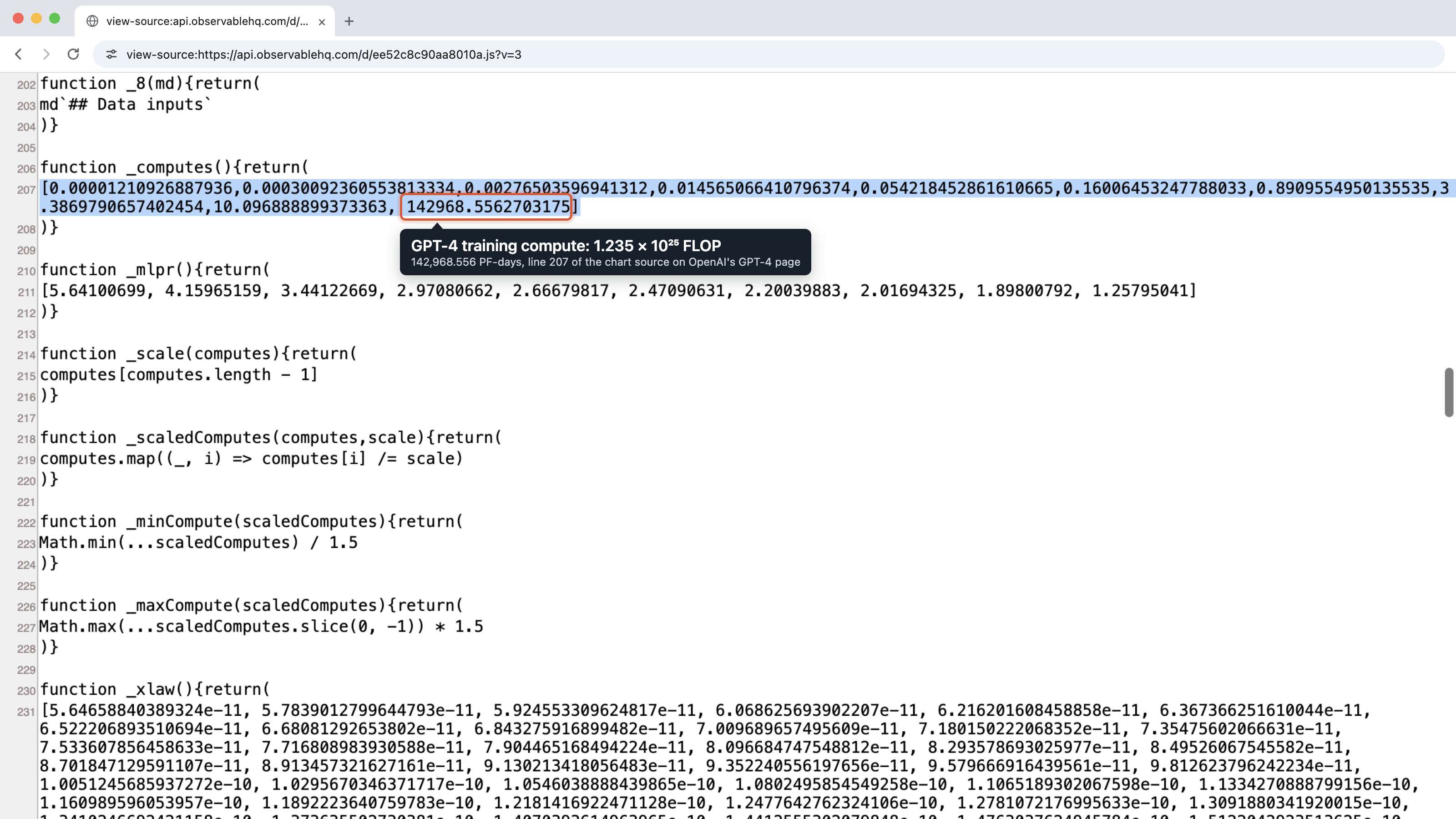
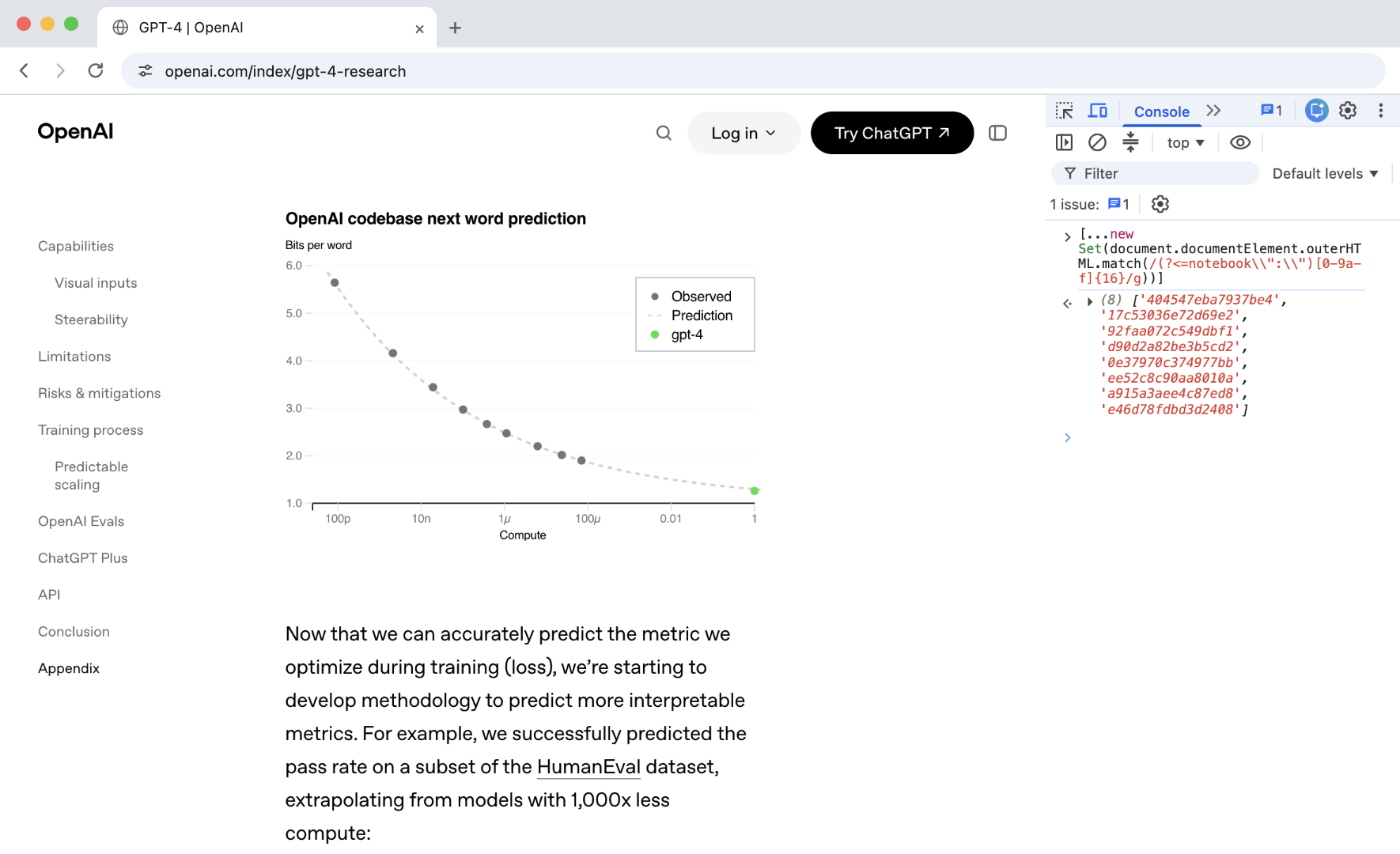
The page HTML names eight Observable notebooks. ee52c8c90aa8010a draws the loss chart.
Line 207 holds the raw compute array. Line 219 divides every value by the last one. The normalization runs in your browser, so the original values ship with the page.
One PF-day is 8.64 × 10¹⁹ FLOP. In that unit, all nine smaller models reduce to one integer formula. The last console line checks each value bit for bit and returns nine true.
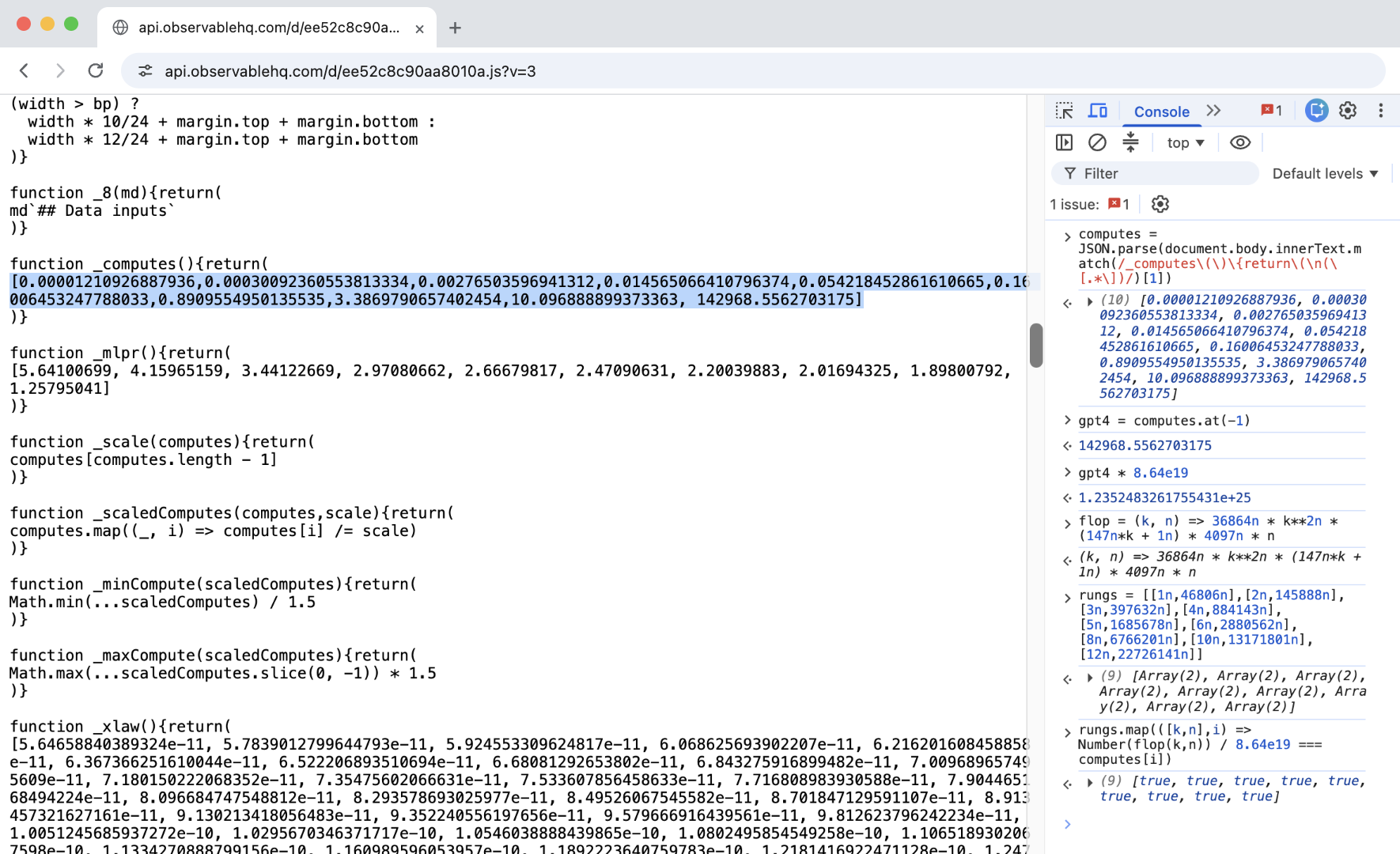
Screenshots are Chrome captures of the live pages on November 22, 2026. The window frame and orange marker were added.
Multiply each chart value by 8.64 × 10¹⁹ FLOP per PF-day and the result factors the same way. For each value, exactly one rung k between 1 and 400 fits. A random value would match a given rung with probability below 1 in 100 million.
| Rung k | Chart value (PF-days) | Decoded FLOP | 147k + 1 | nk | Float error (ULP) |
|---|
The table is recomputed in your browser with exact integer arithmetic. An error below 0.5 ULP means the decoded integer rounds to the published 64-bit value.
Using 6 × active parameters × pre-training tokens, no open model with a disclosed token count has reached GPT-4's compute. DeepSeek-V4-Pro preview is closest, at 79%.
Open-model values count pre-training only and come from each technical report. GPT-4's value comes from OpenAI's chart and may use different accounting. Including mid-training, GLM-4.5 is 4.42e24 and GLM-5 is 6.84e24. Kimi K2.5 adds its reported 15T of continued training to K2's 15.5T, so it is an estimate. Kimi K3 has not disclosed its token count, so its bar is a scenario.
Two chart notebooks carry the same GPT-4 value, 142968.5562703175. The browser divides by it to draw the normalized axis.
Each value matches exactly one rung. Among the integer forms tested, only 147k + 1 fits all nine.
Three rounded constants reproduce the plotted curve to machine precision.
The source has no unit label. PF-days produce the exact structure and round fit constants. Larger units also divide cleanly but imply an implausible 10²⁷ to 10²⁸ FLOP.
This is the chart's compute value. Epoch AI's hardware-based estimate is about 2.1 × 10²⁵, and the two may count different things.
This fits a standard autoregressive data loader, but the source does not state it.
k is a scale index. The formula shows how compute grows with k and leaves open what k counts inside the network.
GPT-4's value does not fit this formula at k = 120, and the same polynomial admits many architectures.
Only the product of parameters and tokens is constrained. The ~60 figure assumes C = 6ND with one pass.
Their five compute values fit this formula at no k from 1 to 200.
If C = 6ND, the parameter count is N(k) = 6144 k² (147k + 1). Each row below produces that exact N at every rung. These are arithmetic examples and none is a claim about GPT-4.
| Width d | Blocks n | Weights per block | Added once | Rungs matched |
|---|